
Restaurant drain cleaning and maintenance · Montreal, Laval and the North Shore
Stop a blocked drain from shutting down your kitchen during service.
Keep grease buildup from turning into recurring blockages. We clean the drain lines your kitchen depends on, with a maintenance schedule tailored to your restaurant.
We plan your drain maintenance.
Off our regular rates for additional drain services, including emergency calls. Terms
Priority handling, subject to our team’s availability.
An annual agreement tailored to your kitchen. Monthly billing available.
See what buildup looks like inside a drain.
Grease and residue cling to pipe walls. Flow slows down and blockages can return. Cleaning targets these deposits to clear the affected lines and restore drainage.


Images from two separate service visits, shown as examples.
Get a maintenance plan built for your kitchen.
Leave your contact details. We’ll get in touch to discuss the lines that need maintenance, the visit schedule and the price of your program.
Tell us about your restaurant.
Leave your details so we can recommend a plan.
We use your contact details to respond to your request. The scope and price are confirmed before you commit.
Preventive drain maintenance for restaurants.
We schedule cleaning for the drain lines your kitchen relies on, based on its workload and blockage history.
Assess your needs
Kitchen type, volume, blockage history and available access points.
Define the scope
Identify the floor drains, sink branches and accessible main kitchen lines to include.
Recommend a schedule
Every six months, quarterly or every two months, depending on the condition of your lines.
Plan your visits
Coordinate maintenance in advance around your operating hours and access requirements.
Document the work
Clean the agreed lines, check drainage and provide a service summary with recommendations.
Your agreement identifies the covered floor drains, sink branches and accessible kitchen lines. Targeted camera inspection is used when it is useful, access allows it and it is included in the scope. For multiple locations, we coordinate a schedule suited to each restaurant.
Hydrojetting for grease-loaded kitchen drains.
Opening a narrow passage can get water moving while leaving deposits on the walls. That remaining buildup can contribute to recurring blockages.
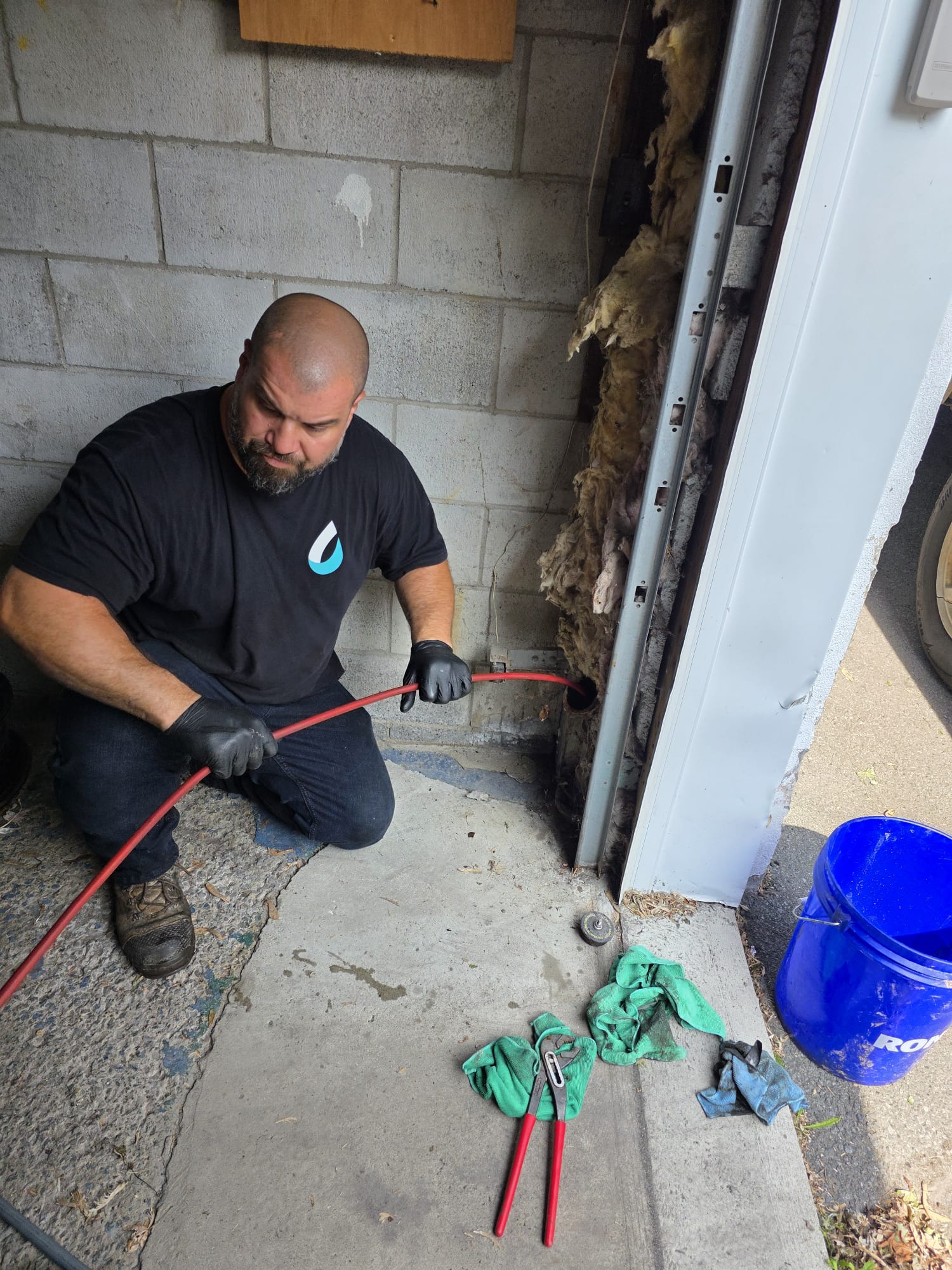
Our commercial equipment delivers hot water at high pressure and high flow, using nozzles selected for the pipe and the type of buildup.
Learn more about hot-water hydrojettingHot water
Helps break down grease deposits in accessible drain lines.
Approx. 3,000 PSI
Pressure adjusted to the pipe and the conditions.
8.5 GPM
High flow helps move and flush out loosened deposits.
The right method
Hydrojetting, mechanical cleaning or inspection, depending on the issue.
See Flow Pro at work.
A short clip of our equipment on a service visit. We select the method and access points according to the lines being cleaned.
The cause determines the solution. Roots, a lodged object, a damaged pipe, poor slope or limited access may call for another method or the appropriate repair specialist.
How often should your restaurant drains be cleaned?
Meal volume, cuisine type, operating hours, blockage history and pipe layout all affect the recommended interval.
Read the restaurant maintenance guideModerate-volume kitchen
Few previous problems and generally reliable drainage.
Busy restaurant
Grease buildup or a history of recurring blockages.
High-volume kitchen
Long operating hours or rapid buildup already observed.
Is a drain backing up right now?
Water rising from a floor drain, a blocked sink or several slow drains? Call our team.
Montreal, Laval and the North Shore.
Independent restaurants, hotels, caterers, banquet halls, franchises and high-volume commercial kitchens.
On the North Shore: Terrebonne, Repentigny, Mascouche, Blainville, Boisbriand, Bois-des-Filion, Rosemère, Lorraine, Sainte-Thérèse, Saint-Eustache, Deux-Montagnes and L’Assomption.
Débouchage FlowPro Drain inc.
2500 Jarry Street East, Montreal, QC H1Z 2C4
RBQ licence 5880-8882-01 · 438-320-0500
Frequently asked questions.
Each program’s scope is confirmed for the restaurant, access points and lines involved.
Ask another questionHow much does a preventive maintenance program cost?+
The price depends on the number of lines, access, cleaning method, visit frequency and number of locations. Once the scope is agreed, we prepare an annual agreement. Monthly billing is available for the scheduled maintenance visits.
Are emergency calls included in the agreement?+
Emergency calls and work outside the program are billed separately. Members receive 25% off our regular rates for additional drain services, including emergencies, plus priority handling subject to team availability. The discount cannot be combined with other discounts.
How often should restaurant drains be hydrojetted?+
Some kitchens can start with maintenance every six months. Busier restaurants may need a quarterly or every-two-month schedule. We recommend an interval based on kitchen volume, past blockages and the condition of the lines.
Do we need to close the kitchen during maintenance?+
We need access to the work area and the targeted lines, which may need to be taken out of use during cleaning. We coordinate the visit with your manager to limit disruption to operations.
Is camera inspection included at every visit?+
Your agreement identifies the checks included. We use targeted camera inspection when it provides useful information, the line is accessible and the inspection is part of the agreed scope. A full inspection may be recommended separately.
Do you always use hydrojetting?+
No. Hot-water hydrojetting is well suited to grease and organic buildup, but mechanical cleaning can be a better choice for some blockages or pipes. An inspection may also be needed if a structural issue is suspected.
Do you empty or pump grease traps?+
No. This service covers clearing, cleaning and inspecting kitchen drains and lines. Grease trap and interceptor pumping must be arranged with a company that provides that service.
Can you maintain multiple restaurant locations?+
Yes. We can coordinate one maintenance schedule for several restaurants while adapting the frequency and scope to each location.
Does preventive maintenance guarantee there will never be a blockage?+
No program can eliminate every risk. Maintenance aims to reduce the risk from gradual buildup and address it before the usual symptoms return.